Sixty days after the AI-EO pass on sixteenmilevet.com, first-party citation rate across ChatGPT, Claude, and Google AI rose from 29% to 38%, the informational blog posts that were invisible on day 0 now get cited by name, human visitors tripled while crawler and AI-bot traffic jumped roughly 14×, and Bing’s AI Performance report logged 1,544 citations with a 6.5× ramp across the window. The “best vet in Oakville” query and Powassan are the laggards.
This is the measured follow-up to Making a vet clinic citable by ChatGPT, Perplexity, and Claude, which covers what we shipped and why. Here we report what sixty days of crawl-and-cite actually produced.
Start with who showed up, measured in Silo CDP. First the people searching — the 61 days before launch laid over the 61 days after, day for day. Then the machines, over that same post-launch stretch, broken out by crawler.
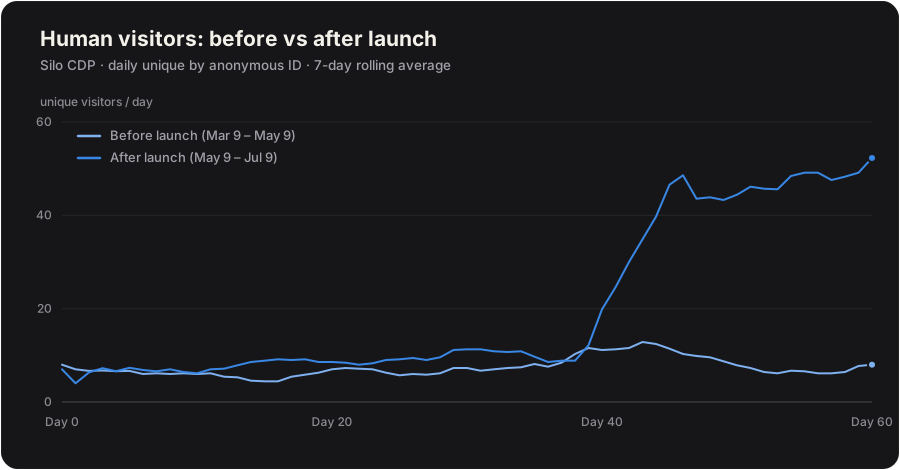
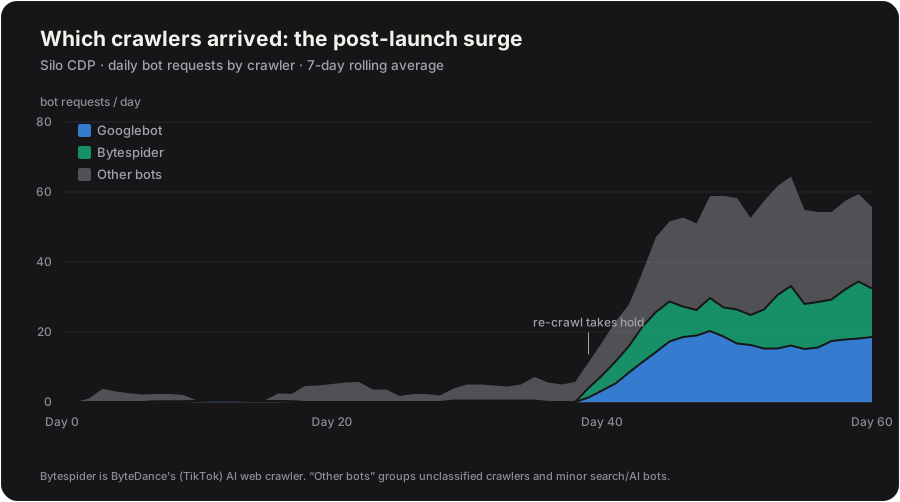
Both run on the same clock. The human lines track together for five weeks, then the post-launch line pulls away in mid-June. The crawlers do the same — near-silent until mid-June, then a Googlebot re-crawl and ByteDance’s Bytespider pour in, everything else stacked behind them. That timing, five to six weeks after launch, is exactly when Google re-indexed the site and Bing’s AI citations started climbing.
What happened around day 40?
Launch was day 0, but nothing moved for five weeks — because getting cited by AI is a chain, not a switch. Google and Bing first had to re-crawl the rebuilt pages (the new robots policy, router-driven sitemap, and
/llms.txtall point them in), then re-index them, and only then could answer engines retrieve and quote them. That pipeline took roughly five to six weeks to clear, which is why human visitors, crawler hits, indexed-page count, and AI citations all inflect together in mid-June rather than at the May launch. The practical takeaway: AI-EO is a re-crawl story — budget four to eight weeks before the needle moves.
We re-ran the same seven queries through the same three engines (ChatGPT with search, Claude with web search, and Google’s AI surface), from a logged-in Canadian session, on day 0 and again at day 60. The queries did not change between runs. “Cited” means the clinic’s own domain appears in the engine’s citation panel; first-party citation — the clinic’s site, not a directory or review aggregator — is the harder bar, and it is the bar every one of these citations clears.
Headline numbers (day-0 → day-60)
| metric | day-0 (2026-05-09) | day-60 (2026-07-09) | Δ |
|---|---|---|---|
| Cited rate (any) | 29% | 38% | +9 |
| First-party rate | 29% | 38% | +9 |
| Brand-mention rate | 33% | 38% | +5 |
By engine:
| engine | day-0 cited | day-60 cited | Δ |
|---|---|---|---|
| ChatGPT | 3/7 (43%) | 3/7 (43%) | flat |
| Claude | 1/7 (14%) | 2/7 (29%) | +1 |
| Google AI | 2/7 (29%) | 3/7 (43%) | +1 |
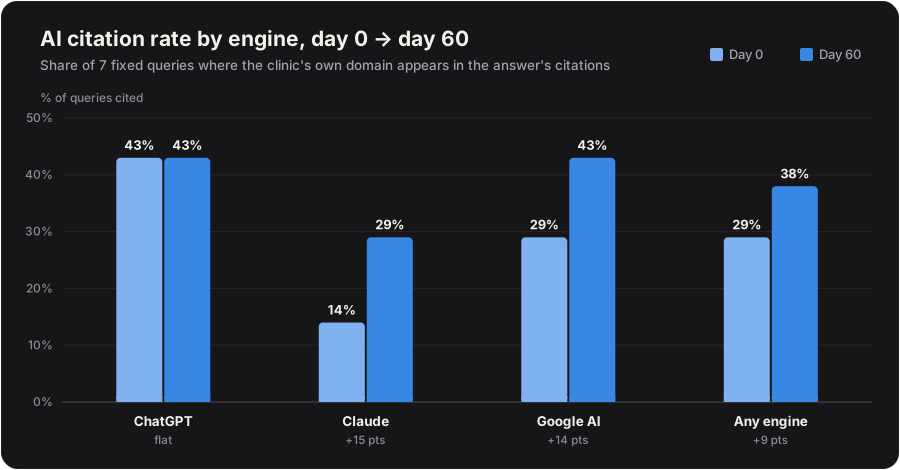
What moved
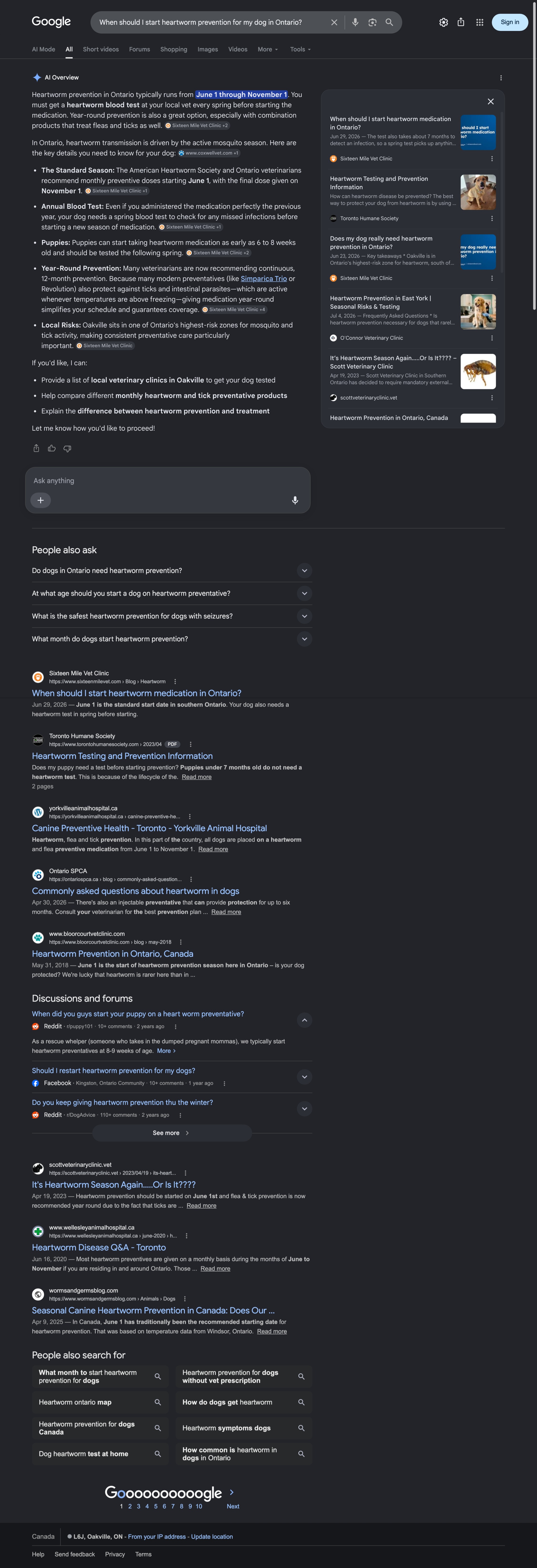
- The slug-match informational queries. Heartworm, ticks, and Powassan — the three queries pointed at specific blog posts — were 0 for 9 across all engines on day 0. This was the load-bearing test: does publishing the answer actually surface the page once it is crawled? At day 60, the heartworm post is cited first-party by both ChatGPT and Google (Google quotes the “June 1 through November 1” window straight from it), and the tick post is cited first-party by Claude and ranks first in Google’s organic results. Two of the three landed. Powassan is the holdout and stayed at zero.
- The
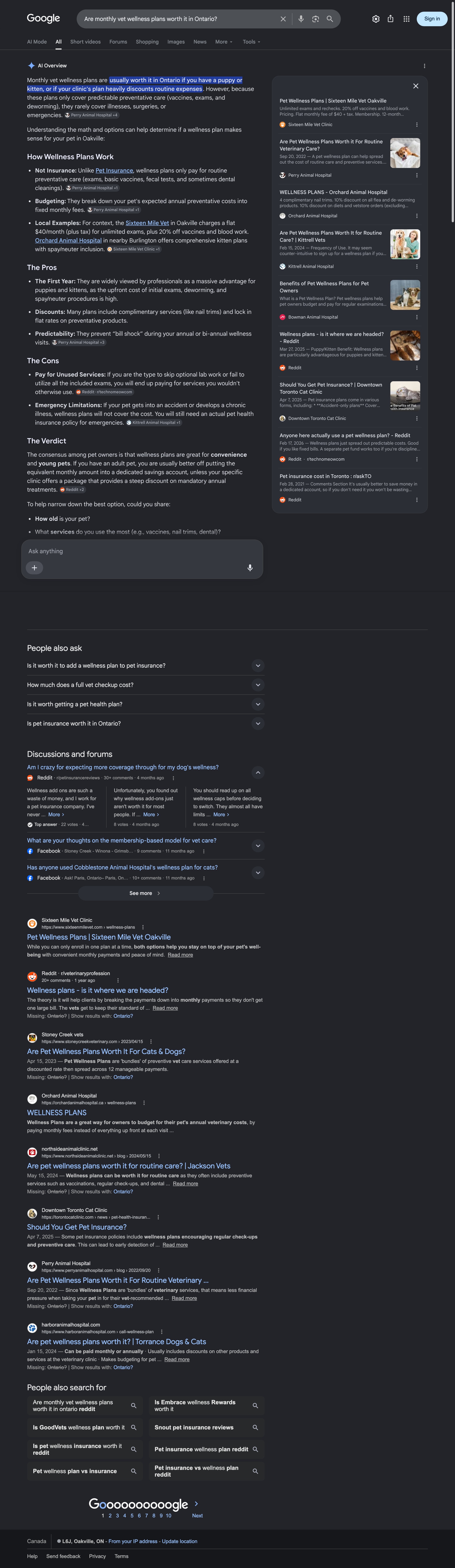
/pricing.mdand SMVC Club content. Google’s wellness-plan answer now reads “Sixteen Mile Vet in Oakville charges a flat $40/month for unlimited exams, plus 20% off vaccines and blood work” — quoted from the clinic’s own plan page. That query returned generic Banfield and Forbes content on day 0. The machine-readable pricing got read and repeated verbatim.
- Claude moved off training data. On day 0 Claude cited the clinic once. At day 60 it cites the clinic first-party on both the branded reputation query and the tick query, pulling the reviewer-aware detail (in-house ultrasound, full-mouth dental radiography) that the E-E-A-T work put on the page.
What didn’t move
- “Best vet in Oakville” is still a wall. Claude and Google both leave the clinic out of their top-list answer for the head local-commercial query; only ChatGPT ranks it (third). The answer both engines now lead with is Southeast Oakville Veterinary Hospital, which trades on accreditation badges (AAHA, Fear Free, Cat Friendly) the clinic does not currently hold.
- ChatGPT’s count held at 3/7, but the mix improved: it dropped a weak, buried pricing citation and picked up the heartworm post at a real position.
- Powassan stayed at zero across all three engines — the one content bet that has not yet paid out.
Supporting signals
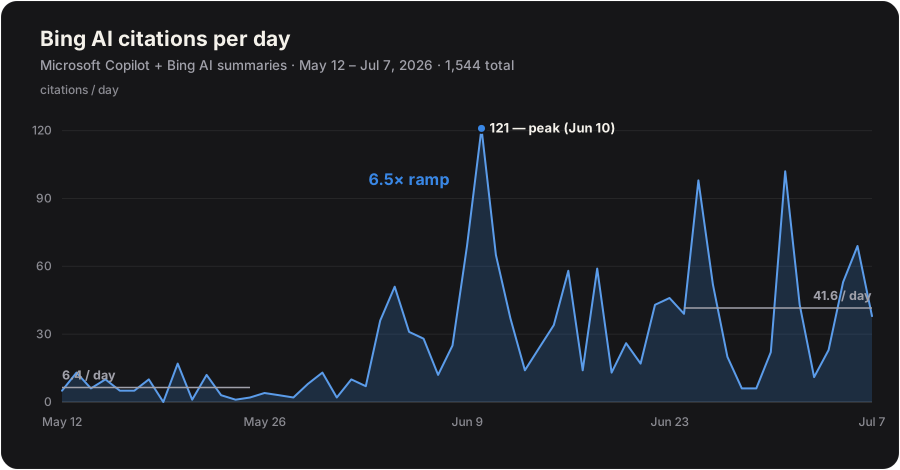
- AI citations, measured directly (Bing AI Performance report — citations in Microsoft Copilot and Bing AI summaries): the site was cited 1,544 times between May 12 and July 7, and the shape of the curve is the point. It ran at 6.4 citations/day in the first two weeks and 41.6/day in the last two — a 6.5× climb — peaking at 121 in a single day. Citation volume was sparse through mid-May and ramped hard across June as the content got indexed. This is the leading indicator the manual citation runs above confirm from the demand side.
-
Which crawlers arrived (Silo CDP, matched 61-day windows;
ubidwas retired mid-run, so counts use anonymous ID): the bot surge charted at the top of this post is a Googlebot re-crawl (5 → 379 hits) plus the first appearances of AI fetchers — ClaudeBot, Bytespider, Meta’s external agent, and Google NotebookLM — none of which touched the site in the prior 61 days. Over the full windows, unique human visitors rose 409 → 1,282 (+213%) and unique bot agents 62 → 865 (~14×). -
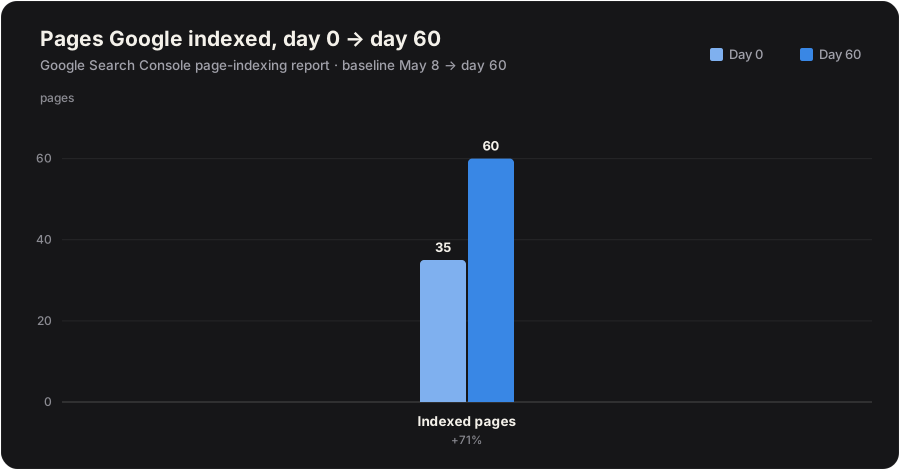
Indexed-page count (Google Search Console): 35 → 60 indexed pages (+71%) from the day-0 baseline (May 8) to day 60, while “not indexed” fell from 109 to 81. Google both discovered the new topic archives and pagination and indexed more of what it had already crawled — the router-derived sitemap doing its job.
- Core Web Vitals (GSC, Chrome UX field data, mobile): 51 of 51 URLs rated “good,” zero poor, zero needs-improvement as of July 7. Field data only crossed Google’s CrUX reporting threshold in mid-June — before that the site had too little real-user traffic to be scored at all — so the result reads as “enough traffic to finally be measured, and every measured URL passes.” Desktop still shows insufficient field data; PageSpeed Insights lab data covers that gap.
- Rich-result eligibility (Google’s Rich Results Test): the homepage validates as LocalBusiness, Organization, and Review Snippet — all eligible for rich results — and the blog posts validate as Article and Breadcrumb. The
FAQPagemarkup is present but no longer surfaces as a Google rich result — Google retired FAQ rich results for most sites — so it now earns its keep by handing AI engines a clean question-and-answer structure to lift from rather than by rendering a SERP dropdown.
Methodology
7 queries × 3 engines × 2 dates = 42 manual UI captures. Queries were grounded in real Google Search Console data — top impressions, blog-slug matches, and /pricing.md content — not plausible-sounding guesses. We measured in the consumer UIs rather than the provider APIs on purpose: the API’s web-search tool is a different surface (different backend, no consumer system prompt, no personalisation), so its citation rate is not a reliable proxy for what a real user sees. Screenshots and the per-query rationale live in the agency repo.
Sources
- The implementation this measures — Making a vet clinic citable by ChatGPT, Perplexity, and Claude
- Sixteen Mile Veterinary Clinic — sixteenmilevet.com
- Bing AI Performance report — Bing Webmaster Tools
- Google Search Console — Page indexing and Core Web Vitals reports